Origins: Early Explorations Towards Abstraction.
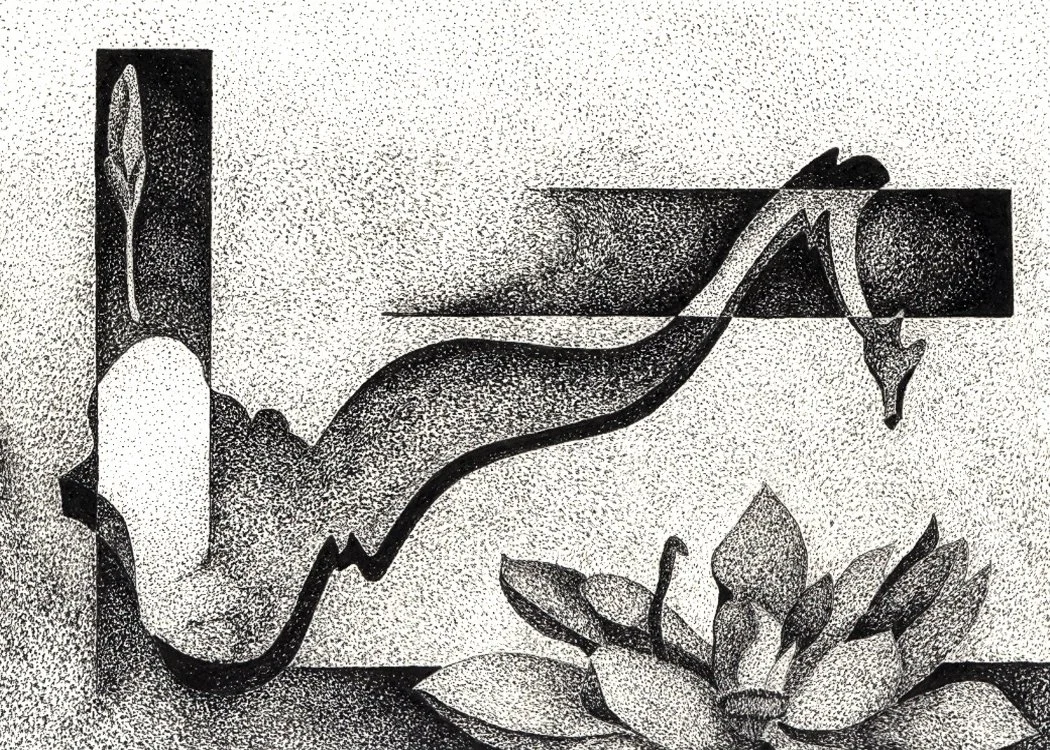
Pen and ink contemporary fine art by Doug Ashby.
After recently writing about an early artwork from my New Myths series, I realized there were even older pieces that reveal the earliest stages of the path that eventually led me here. This journey, one shaped over almost twenty years of working with stippling, began long before I understood what it would become. The artwork I am reflecting on today is titled “Everything That Is Solid Melts Into Air.” It is a seminal piece in my development, one that continues to reveal things about the artist I was becoming and the one I am still striving to be.
The piece itself is anchored by a single invented form that dominates the center. It flows with a sinuous, curved movement, yet punctuates that flow with singular, sharp edges that give it a restless tension. In the lower right, a lotus unfolds, its petals rendered by careful stippling and serving as a quiet counterpoint to the central shape. To the left, contained within a tall rectangular block, a tightly closed lily or tulip stands vertical — an enclosed promise, compact and restrained. The juxtaposition of the open lotus, the closed bud, and the hybrid central form creates a dialogue about emergence and containment, about the push and pull between softness and an almost architectural firmness. The stippled field around these elements gives the work a mist-like atmosphere, a sense of quiet hovering between solidity and dissolution.
Before discussing what the work means to me today, I want to explain why I am returning to these early pieces. I want to better understand the processes I relied on back then, and how my life at the time shaped the art I made. I discovered the stipple technique in 2006 on the advice of a professor while I was completing my master’s degree in art education. I had no intention of becoming a full-time artist. In fact, I assumed I would retire as a teacher, even though there were already signs that the profession didn’t quite fit me. Yet the positive feedback I received on my pen-and-ink explorations planted a seed that took hold and never let go.
When I created this artwork, I was deliberately pushing myself toward abstraction and toward ideas that asked more of the viewer. I wanted the shapes to feel invented yet rooted in the natural world, like echoes of forms we recognize but can’t fully name. I wanted something atmospheric, something ethereal. The title came later, after the work was finished, and it felt charged with meaning. It held a kind of mystery that deepened the questions I hoped viewers might sit with.
Interestingly, this was one of the last artworks I titled in such a poetic way. Afterward, naming my pieces became increasingly difficult. Eventually I defaulted to naming by series or simply leaving the work untitled. I am not entirely sure why. Perhaps I felt that titles were beginning to impose meaning rather than open it. Perhaps I was avoiding the pressure of assigning a single phrase to something that felt more expansive. Revisiting this piece makes me wonder whether that avoidance served me or limited me. It may be time to reflect more intentionally on the role a title can play in shaping how a viewer receives a work.
Before this piece, I had created another artwork featuring a lotus flower that ended up in a close friend’s collection. I no longer have a digital image of it, but I remember feeling at the time that the lotus carried a natural connotation of serenity and quiet contemplation. Tranquility was something I desperately sought in both life and art. The stipple technique, with its minimalism and patient accumulation of mark after mark, offered a kind of stillness I could hold onto. Looking back, I’m sure this intention was shaped by the turbulence of my life then. Art became a retreat, a place where I could create the calm I could not always find elsewhere. It has always been that for me, though I understand now that this cannot be the sole purpose behind why I create.
This leads to the larger question I continue to wrestle with: Why do I create, and why does the impulse refuse to leave me? I want meaning and purpose in my creative life. I want my art to be the primary way I engage with the world and with the economy. Teaching has its own profound purpose, especially across decades. There are moments of deep impact that stay with you, sometimes only realized years later when a former student returns to say so. I am grateful for that. Yet even during those years, another voice persisted. It kept calling for my attention.
That same voice motivates me now to revisit these early works. I see consistencies between who I was then and who I am now. I still work to capture calmness through abstractions influenced by the natural world. After this piece, I created a small series exploring similar ideas, though none felt as resolved. Pure shape invention has rarely played such a central role since, yet the desire to challenge the viewer’s perception of nature has only deepened. Why this continues to matter to me is a question I am still uncovering.
One truth has persisted throughout my career, and I am only recently learning to accept it. My ego plays a significant role in my creative drive. I understand my technical limitations. I am not the kind of artist who can render with photographic realism. At best I touch on it briefly, then it slips away. What endures instead is the desire — the ego-driven belief — that the ideas I express through my art are important and worth sharing. I am beginning to understand that clinging to this belief can hinder growth. I may need to let go of some of these ego-driven motivations in order to evolve, to connect more authentically, and to build the kind of connection I long for.
So where does that leave me? I still feel a strong desire to create, and an equally strong need for my art to become the primary driver of my economic life. This is the hope that early pieces like “Everything That Is Solid Melts Into Air” ignited in me. I carried that hope openly. Twenty years later, I have made progress but am still on the edge of taking the leap fully. I am closer than ever to having the stability to take that risk. I know that path carries its own challenges, yet I also know it is one I have to pursue.
For now, I will end this reflection here. What I’ve discovered is that my deepest desires have endured. I feel on the threshold of a moment where I can let go of the ego that once shielded me and instead create from a place of humility and openness. I do believe I have something to say through my work. It doesn’t always come through as clearly as I hope… but still I show up, I create, and I offer the work to anyone who wants to engage with it.
More than anything, I want art to be the center of my life because it fulfills me in ways teaching never fully could. Writing and reflecting on this journey is becoming meaningful in its own right, a way of understanding how I arrived here and where I might be heading.
I hope you enjoy both the artwork and the writing. New work is on the way. If you feel called to respond, I would love to hear from you. Please leave a comment, I promise I will respond.
Thanks,
Doug