Ode to Redon #2: The Leaf in Winter - On Letting Go and Discounting Our Future Selves
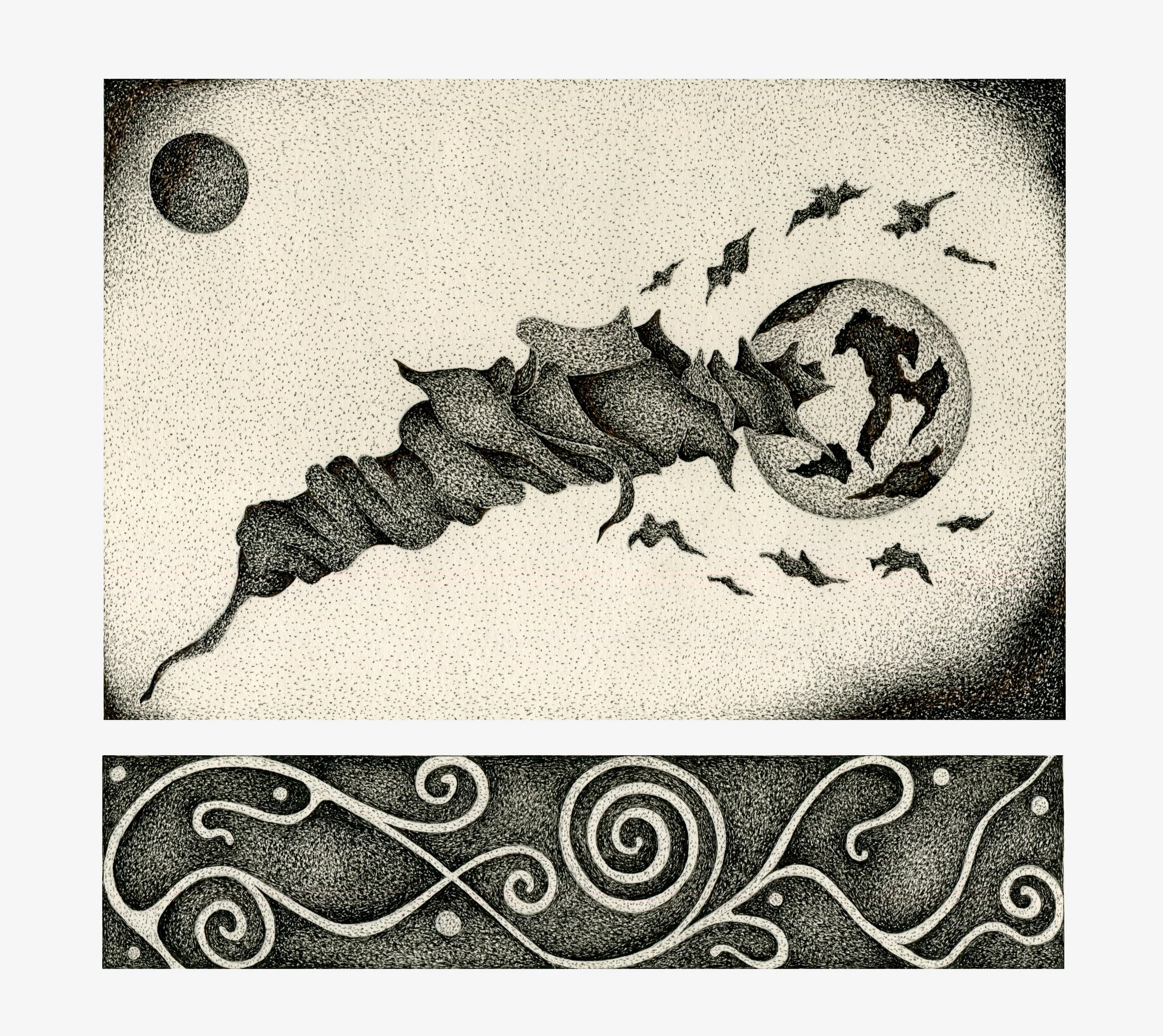
Pen and ink contemporary fine art by Doug Ashby.
Things capture my attention all the time. I have written about this in the past. Wherever I may be, I work to keep my attention open and outward for curious and interesting things that pique my interest and have the power to be transformed into art. This is especially true in nature. The above artwork is an abstraction of a leaf that had shriveled up in early winter yet was still clinging to the branch it was a part of. The folds and twists undulating in, out, and over each other provided a rich visual that I felt would fit perfectly with my work. This isn’t the first time I have turned to such visuals for inspiration, and it will not be the last. The leaf, as seen, is in a moment of transition, one could say its final moment. Yet the life that gives rise to the leaf continues, and in the spring the cycle will start again, offering up a window into the never-ending work of becoming.
Abstraction allows me to both explore visual imagery in new ways and delve into realms that lie beneath the immediate. Within the folds and shading I created on paper lies not just a rhythm that captures one’s attention, but also an avenue to plumb the depths of what it means to hold onto something—as well as let go. Fragments of the leaf fall off and float away as the process of becoming occurs, even if we are unaware. Beneath all of this exists a pattern of constant growth that in many ways we take for granted. We overlook the power of what these spirals and cycles have in store for us.
In a recent podcast with author Mark Manson, I was taken by his notion that we often discount our future selves at the expense of the current station we occupy. We move through life making decisions without taking into account that we will be different people in the future. Yes, much of who we are will remain, but we cannot simply stop the progress of forward motion. We continually build narratives that support how we interact, show up, and understand our place in this world. Not allowing for the truth that these narratives will grow, change, and evolve hampers our ability to gracefully become who it is we are meant to be. The leaf is not a static entity, and neither are we. Seasons begin and then ultimately end, and on this continual path, renewal is inevitable.
In many ways I feel akin to the leaf in winter, and with that I am asking myself often: who is it I am? And furthermore, why is this important to me? Why must I feel as though my identity is that of an artist? Why is it I sometimes want to strongly reject my identity as an art educator? Does who I am actually have to be tied directly to either one of them? What I am beginning to realize is that I do not have answers to these questions, as they may not be ones that need an answer. Within all of this I do build narratives that create tension. One of them is that I must continue the current course I am on because it is safe. There is security in the moment that, in reality, is exceptionally tenuous. None of us are soothsayers, and belief in a static idea for the sake of perceived stability is denying the inevitable unknowns we all exist with. There is irony in that as a teacher, I encourage my students to embrace discomfort for the sake of growth but protect myself from it. In order to grow, though, we must recognize that—while it is unsettling—allowing ourselves to fragment is what pushes us into what comes next.
There is a paradox in all of this as well. In ten or twenty years I will not be the same as I am today, yet I will still be myself. Discounting this paradox and working to protect who I am today may hamper the trajectory of who I am becoming. That person may be more free in terms of letting go of the struggle to understand, the desire to be recognized as an idea of identity. Therefore, in releasing, or dispelling, the notion that my self and self-worth are defined by made-up cages, I prevent the unexpected growth that must happen in order to become. The leaf, despite fragmenting, is still that same leaf. And in the spring a new version of itself will emerge. It will be amazingly similar, sharing so much of what once was, but it will have new patterns that interact with the world and perhaps speak new inspiration across time and space that become new manifestations of creative energy. Letting go can be quite terrifying, yet it is a significant step into embracing the inevitable and allowing oneself to become.
There is a cost, of course, deeply embedded in not accepting our own evolution. The narratives and stories that once served us so well become the very constraints that prevent growth and transformation. Is it possible to grow from a place that we perceive to be safe and necessary? There always exists a part of us—pieces—that want to break away. Are these seen as losses or liberations? More than likely they are both. We strive to know what it is we simply cannot know, and this stasis creates an unhealthy cycle that stands in our way. Sitting with the unknown, allowing oneself to be comfortable with not knowing if our desires and predictions will ever come to be, must become the dominant narrative. The story, therefore, has no real conclusion; it’s simply ongoing.
The arc of human cycles is much longer than the ones we witness in nature unfolding year in and year out. The patterns of these cycles, represented in the bottom panel of this artwork, appear everywhere. They exist at the tiniest of our micro scales to the largest of the macro. Despite being a deeply connected part of nature, we are not leaves on trees. We are acutely aware of our consciousness and all that comes with that. Perhaps art, then, provides a safe space to practice dispelling ourselves of conceptual self and understand, and accept, more gracefully a larger view of not just the self but the self’s place in the larger whole. These cycles, no matter how long or how short, demand our attention. It is within them that growth occurs. There are specific moments in life when we are presented with this; those moments are simply a meeting point with the larger, more eternal patterns we exist within.
I should turn more to my own work as an artist for instruction. The process alone never unfolds in ways I believe it will. I must surrender to the act of seeing what becomes as each dot is laid down, as the next dot interacts with the previous, and so on. As I continue, each piece becomes a fragmentation of older beliefs on what my work can be and become, and sets the stage for opening the space that allows for the next piece, and the next. Despite trying to control and influence aspects of my life that allow for safety and security, I surrender myself to a process that in many ways is beyond my control when I create. The work, then, serves to teach what is needed at the time and to grow with it. I have set down tens of thousands—perhaps hundreds of thousands—of dots in my life as an artist. Each time I trust what it is I cannot see. Perhaps that trust deserves to spread wider.
Then comes the question: is true courage understanding that having the answers is somewhat of a falsehood, but that we should not stop asking questions? Challenging the very narratives we may be protecting that, in the end, are stopping us from seeing the fragmented pieces as a way forward rather than a destructive force? Is courage then trusting the cycle regardless of not knowing the outcome? By no means do I believe this is the first time I have confronted moments where accepting the unknown and the changes that may bring stand before me, nor do I believe it will be the last. This time, however, I hope to see that if I discount the fact that I will be different in so many ways, yet the same, I can allow myself to move forward feeling more trust. What floats away may or may not come back. However, those fragments are just that, and they do not define who we are entirely.
We live in the in-between constantly. Between who it is we are and who it is we will become. My dialogue with Redon continues then with him, myself, my art, and those who view my work. I am sure that when Redon was a young artist exploring the darkest sides of the human psyche, he did not know he would create artwork that would transform who I am as an artist, and that would lead to a pursuit of understanding that is more free and less constraining. I don’t know when this series of work will conclude; I feel it will speak to me for some time. The one thing I understand, though, is that on the tenth piece I will be as different as the art is from this second piece. I need not stress over that, fight it, or discount this; I merely need to allow for it.
Peace does not come from holding onto what was or is; it comes from the willingness to fragment and grow from there.
As always, I hope you enjoy the artwork and writing. The comment section is open, so please by all means leave a message. I very much would love to hear your thoughts and start a conversation. If you are interested in purchasing this artwork please click here.
Thanks,
Doug