Between Order and Indifference: A Dialogue with Odilon Redon
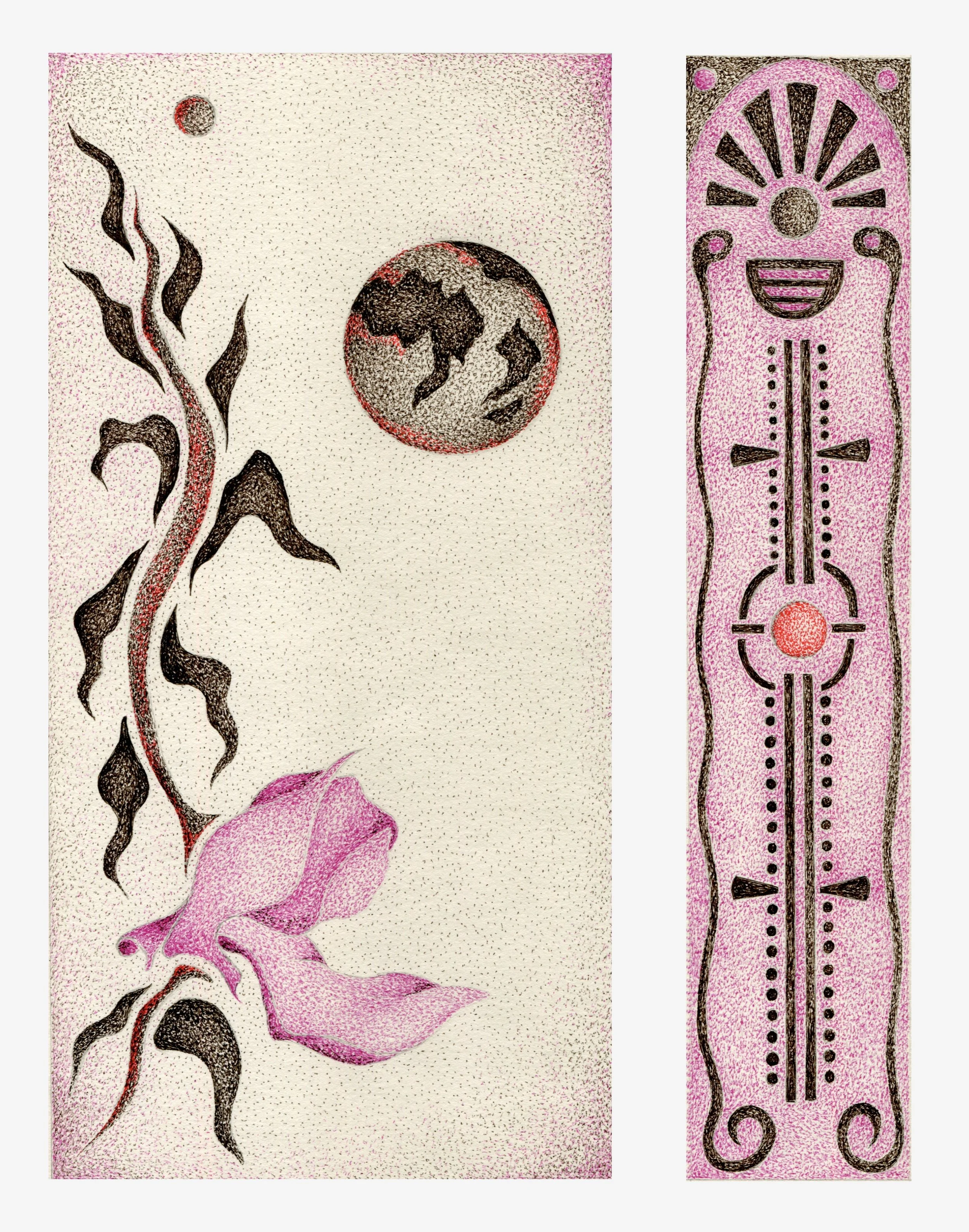
Pen and ink contemporary fine art by Doug Ashby.
It was the last thing I expected when moving through the third-floor galleries at the Musée d’Orsay. Having studied art history and even worked at the Museum of Modern Art, I felt as though I had a strong grasp on the art within. Yet I was left completely speechless when I encountered Odilon Redon’s work from the Château de Domecy. I only had a few hours to see what the museum had to offer, but this work, its quality of light and atmosphere, left me breathless and moved in a way that still resonates half a year later. More importantly, it has begun to inspire.
What struck me most was the deep emotional and intellectual response I had instantly. I could not move forward; I physically had to slow down and simply be with the work. The florals danced in an ethereal backdrop of such brightness that it contrasted with everything I knew about Redon and his art. As work I had never encountered before, it felt as though he had made an enormous evolution with these commissions. It resonated deeply with me as I saw connections in my own practice. In the time since, I could not help but feel drawn toward a direct response to this work—not a copy, but something that would reveal avenues I had been ruminating on already. It was as if the work opened a door that had started to crack and showed me what the muse had in store.
The artwork above is my first in a new series titled, provisionally, “Ode to Redon.” For as long as I can remember, I have been teaching my students about the triptych, a specific design layout, and challenging them to create unique artworks that utilize this format. In truth, I have been in love with the diptych for far longer. I believe it was the work of Julie Wachtel in the 1980s that first piqued my interest. What we have here is something I have been thinking about for some time: how to reconcile the relationship, the tension, between human attempts to order nature and nature’s indifferent, cyclical forces.
Nature offers so much beyond our control, yet control is what we continue to attempt. On the left, nature floats in a laughing manner toward our desires. On the right, we see the rigid control we seek over what we simply cannot control. Yet we find a productive tension in which we exist. It is never perfect, and in many ways we are subservient; however, we still strive for things beyond our grasp. It’s as if the moons represent a heaven that exists to tempt us into a cooperation that remains elusive. Within this contrast, we find ourselves between the earthly—our plane—and something so much larger.
Some critiques of my work have gestured toward transcendentalism. I am passingly familiar with this philosophy and can see the connection. I have read some Emerson, but I confess that’s about it. I recall in college my roommate spending a few days reading Thoreau and being quite taken by it. While reading Emerson myself, a colleague asked why I would undertake such a thing. I found it challenging and engaging in an abstract manner. While I would not describe my work as purely abstract, it’s undeniable that abstraction is an area within which I operate. I desire to establish concepts that the transcendentalists upheld: nature is very much nurturing and yet indifferent; there are limits to human agency within universal structures. So I use familiar objects taken from a common language of nature itself and place them in moments that are born into existence nearly as fast as they are taken from it. I believe in the ineffable. I believe it fuels what I do, for I have no other explanation for why I keep returning to art other than pure love.
Let us return for a moment to Redon’s work. As I stated above, I was not at all unfamiliar with him and his art, particularly his noirs. These were dark works that brooded on the deepest and most desperate aspects of our human existence, questioning one’s own being, the “why” of horrible tragedy, and the reality of human failing. Naturally, when I saw the work from his commission for Baron Robert de Domecy’s château, I was caught in a moment of imbalance. His use of natural forms refocused the lens outward instead of inward. The work was more subtle and more mature than anything I had seen from him before. Upon doing a little research, I learned that the work coincided with him having a child, something profoundly transformative.
What I saw reminded me of something an individual said about my work in a comment on LinkedIn: I saw the “quiet wisdom” that existed in Redon’s work. It was exceptionally profound, yet in its aesthetic, it was not clobbering you over the head with that profundity. I imagined the art hanging on the walls of the château and simply being. One could exist in that space with it, without it being overbearing, and it would still command attention. Quietly. This is something else that a fellow artist once said about my work, and after that moment in the museum, I knew deep down that I would allow that experience to shape my work further.
So, the above artwork. Before I begin, let me say that if you have not yet seen the Redon work I am speaking about, you should. A simple Google search for “Redon Château de Domecy” will get you started. What you will not see there are many diptychs. There are two paintings that work together similarly; however, they could also stand alone. What I have created is meant to stand together as one piece. My desire was to create an artwork that was recognizable to what I do yet began spreading outward, an abstraction of nature pushed a bit further and very purposefully juxtaposed with something much more rigid. I wanted to develop a contrast between the flow of organic time and the human constraints we place upon that, inviting the viewer safely in while placing a seed of silent discord that challenges one’s conceptual place in nature.
As stated before, the diptych is something I have worked with in the past and has sat with me in my mental visual space for decades. It serves well the need to place together entities that have stark divisions as well as commonalities. This series, of which I am currently developing my fourth piece, all utilize this design strategy.
The left panel is the direct ode to Redon, so much so that I even questioned if it was too much, going so far as adding color, which is something I rarely do in my work. In reflection, I don’t believe this to be true, as it does fit within my body of art created. However, I began deconstructing more than I have in the past. All elements of the flower float separately from each other, decoupling what should be whole. Is this a sense of decay? Possibly. Or is it how the universe assembles order from the disparate? Movement was important to me. I wanted a weight at the bottom to be counterbalanced with a similar gravity upward that still carried lightness. I strive to create a sense of vulnerability that lies at the center of strength, working in tandem.
The right panel presented a greater technical challenge for me. My strength does not lie in more formal design or decorative work. I very much chose this path for this series to work on that, as I have always felt it would be a great addition to my practice. I cannot deny that the genesis of this path, the decorative addition, was more than likely born out of the Art Nouveau work I saw the same day at the Musée d’Orsay. I have long enjoyed that genre and from time to time have strived to incorporate it. Humans have long sought to find order in the larger universe, a sacred geometry that explains all. Despite this pursuit being so difficult it’s nearly done in vain, yet we persist nevertheless. It’s both a strength and a weakness, a conundrum that drives us forward. I sought something that stood in contrast yet balanced well in both imagery and tonality, again seeking to explore the tension that lies within our perceptions of agency, control, and lack thereof. This is not new. Artists have been exploring this tension since the dawn of homo sapiens. My supposition is that it will continue on indefinitely.
Together, these panels form a whole, the start of a larger narrative I hope to explore in this series. That narrative concerns how we as humans are required to hold many truths that are seemingly contradictory at the same time: order and chaos, nature and our place within it, control and lack thereof. There is a beauty in these contradictions that, once we crack the window on accepting them, can usher in a much more expansive view of who we are within this vast cosmos. As insignificant as that truly is, at the same time it allows us to be further at peace, and as a result, we move to a higher understanding of what it means to be human in this world.
As I get older and gain a more expansive view, I stop asking as many questions as I once did and I simply surrender to what is. I cannot stop making art. I know deep within that I will do that, in some capacity, until this flesh entity ceases to exist. For the foreseeable future, I remain committed to the dots—stippling. It’s a process that forces me to slow down in this ever-increasing, fast-paced world we humans have constructed, one that we cannot escape. My art becomes resistance to contemporary society’s speed, a safe place that allows me to create and explore the very themes that coincide with the act of creating. It’s very spiritual and meditative. I simultaneously control the placement of each dot and surrender myself to the fact that with each dot comes an unpredictable outcome. As the piece progresses, it takes on a life very much of its own, influenced by the muse. I become a partner in that, not the sole creator. It’s laborious for sure, but becoming lost in the moment is worth much more than the cost in time.
More and more, I think about the viewer’s experience with my work. It weaves throughout. I used to not consider this so much until I began teaching my students that, at its core, visual art is a communication between the muse, the artist who brings it to life, and the viewer. There is an invitation I hope to extend through the art itself. From there, I welcome all down the path of the art and my writing on it, in the hopes that the first attempt at communication creates a dialogue that nurtures both parties. I want my viewers to feel as though they are a part of this journey I am on—that they are not just mere passengers but participants as well. It’s true that each piece I create gets released and then I move on, yet the conversation I have with the viewer is essential in what comes after. It forces me to consider new avenues and open myself up more fully to what this universe asks.
With that said, this work is a conversation with Redon. It’s part of that ongoing dialogue we have with those who came before and those who will come after. I am simply trying to be a part of that and do what it is I cannot stop doing. I know that I personally will never reconcile the larger mysteries of the universe I explore here, and that is fine. However, as I continue, I realize the work is not truly about converting these dichotomies into a unified truth but more about accepting and living within them. In between these spaces lies an area where we all exist. There is peace in that realm that is worth striving toward. Hopefully, what I do helps not just myself understand that more deeply but others as well.
As always, I hope you enjoy the art and the writing. I would love to hear your thoughts on this work, so please leave a comment. I promise that I will respond and start that conversation.
If you are interested in purchasing this artwork please reach out through my contact page and we will go over the details.
Thanks,
Doug