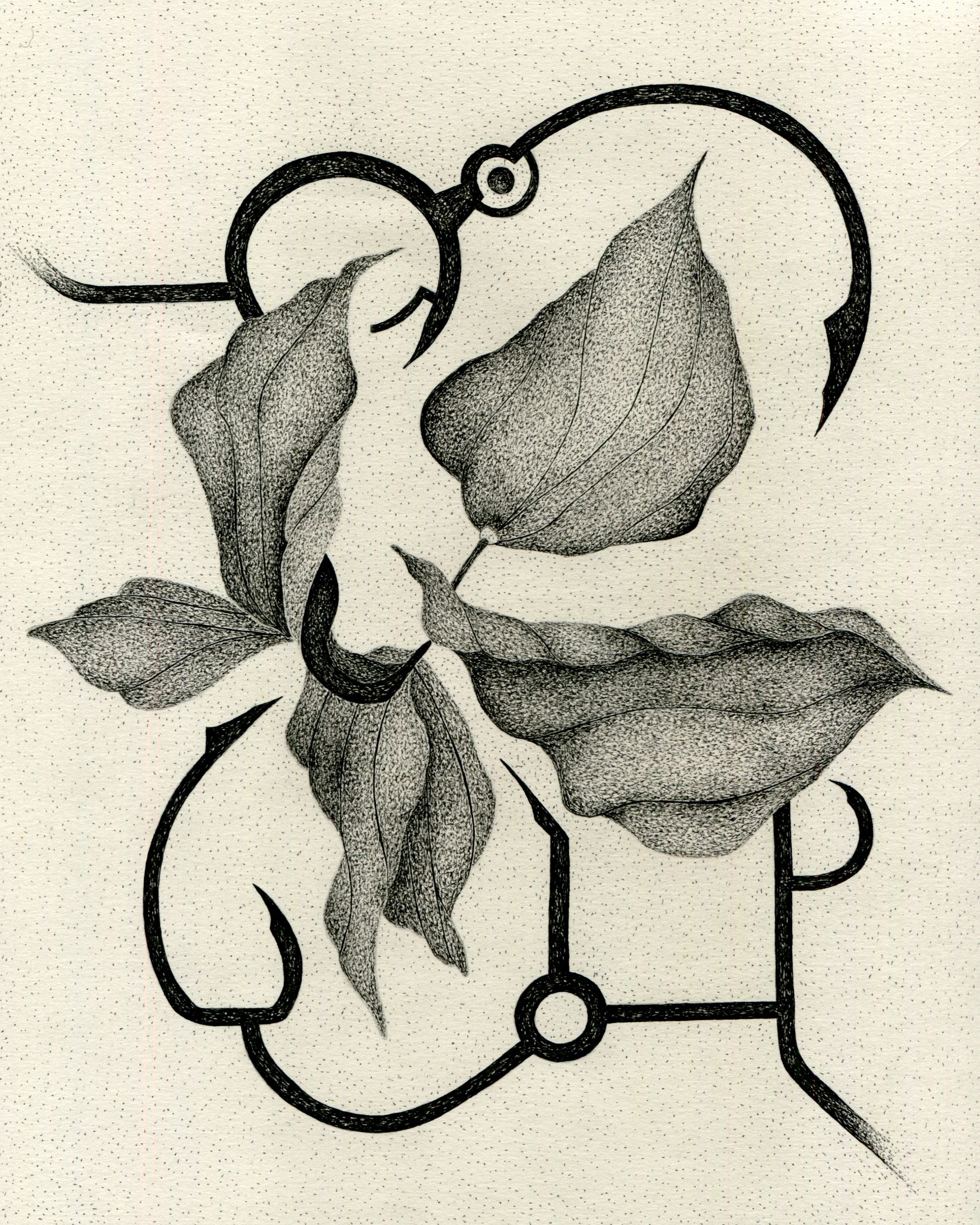
Pen and ink contemporary fine art by Doug Ashby.
It is difficult to recall the first time I truly encountered architectural drawings and became fascinated by them. I can say definitively, however, that growing up I always had an affinity for maps. The structures created to identify boundaries, elevations, city plans, and geographical features were a source of joy and inspiration. In many ways, they aren’t all that different from architectural drawings. Yet I don’t think it was until college, when I began developing a deeper appreciation for architecture and the drawings architects created to bring their visions to life, that this fascination took hold. It is an appreciation that has ultimately led me to this moment.
In college, I took a number of art history courses. At the time, I thought this was the direction my career would eventually take. Working in museums was a goal of mine, although I was young and, as it turns out, am only just now beginning that journey. Architecture was a recurring subject in my art history studies, and those conversations continued to shape my interests. Then, in the summer of 1992, I had the opportunity to intern at the Museum of Modern Art in New York City. What an immersive experience it was. It was there that I began making connections between art and architecture that would stay with me and eventually emerge in my own work, all these years later.
A trip to the Guggenheim was really all it took. The building was extraordinary to behold, and the experience of viewing the art inside was equally unique. It was there, alongside a few courses in modern art, that I discovered the work of Frank Lloyd Wright. I purchased a book at the Guggenheim devoted exclusively to Wright’s architectural drawings. The inspiration I found in those pages has stayed with me ever since. Now, that inspiration finds its way into the artwork above, where it intersects with the abstract visual language I have been developing for some time.
There has always been a nagging tension in my mind about how to bridge the distance between what naturally emerges from my artistic practice and my fascination with architectural drawings. In the past, I created a series of abstract works based on city planning maps. However, those pieces existed largely on their own and, in many respects, never felt as fully realized as the work above.
This piece, titled Ode to the Architects 1, will be the first in a series exploring the connections, dichotomies, and similarities between the organic elements of the natural world and the ways we, as humans, build and create. My intention is to study the drawings of some of our most celebrated architects and find ways to incorporate their ideas and visual language into my own work.
There was no more natural place for me to begin than with Wright.
When I first encountered his drawings, I was enthralled by the natural way his designs brought together linear and geometric elements. There was a balance to them that seemed almost inspired by nature, particularly in the way his architectural forms occupied and responded to their environments. And this observation has nothing to do with his seminal work, Fallingwater, which quite literally does just that. No, there was something much more subtle in his drawings that made them impossible to forget and continually drew me back to them.
Reflecting on my desire to integrate architectural elements into my own drawings, I recognize both a certain naiveté in my initial approach and, more importantly, a springboard for meaningful growth. I see possibilities that I hadn’t fully considered before.
And I find that rather exciting.
The architectural elements in this artwork were inspired by a drawing Wright created for the home of Dr. Ronald S. Grover in Syracuse, New York. Wright produced nine drawings for the residence, although the home was never built. While researching the project, I discovered that the original drawing I used as a reference may be housed at the Museum of Modern Art. Such irony.
When I worked there as an intern in the education department, one of my responsibilities was retrieving slides (yes, this was before the days of digital imagery) for curators and guest lecturers. I can only imagine that a slide of this drawing may have been somewhere in that collection. I digress.
The drawing is an aerial view, and what immediately struck me was the repetition of circular forms and how Wright incorporated them throughout the design, at both large and small scales. I would often point out to my students how they could use subtle repetitions of shape in their artwork to attract and hold a viewer’s attention. Here was a wonderful example of that principle in practice.
In much of my own work, I explore this idea through spherical forms, particularly my moons. Here, I am essentially doing something similar, albeit through a more abstract approach. I am working to establish a visual connection between distinctly different forms of imagery: the organic and the geometric.
And that is the goal of this new series: to bring harmony to these design elements, to the human-created world and the natural environment, in a way that is visually compelling while incorporating an art form that has inspired me for so long.
I began with Wright, but my intention is to venture much further. I want to look to the past, across geographical and cultural boundaries, as well as toward the future. I hope to develop a deeper understanding of the role architects play in our society beyond simply creating the places where we live and work.
Architecture is art, and many of its great practitioners have demonstrated just how powerfully it can be. Yet architecture also has a utility rooted firmly in the practical. The challenge of balancing that practical necessity with ideas of beauty, shaped by time and place, presents an intriguing avenue of exploration. I see this as an opportunity to expand my knowledge while laying new foundations for what might be possible in my own artwork.
As always, I hope you enjoy both the art and the writing. If you would like to respond, please leave a comment below. I promise to respond, and perhaps we can learn something from one another.
This is the first piece in a new series, so stay tuned for more.
In the meantime, this original artwork is available for purchase.
Ode to the Architects 1
Price: $800
Dimensions: 8” × 10”
Medium: Archival ink on acid-free, 190 lb. paper
If you are interested in purchasing this piece, you can do so here. And if you have any questions, please reach out through my contact page.
Thanks,
Doug