The Virtue Trap of Automaticity: Why working on autopilot is both a blessing and a curse.
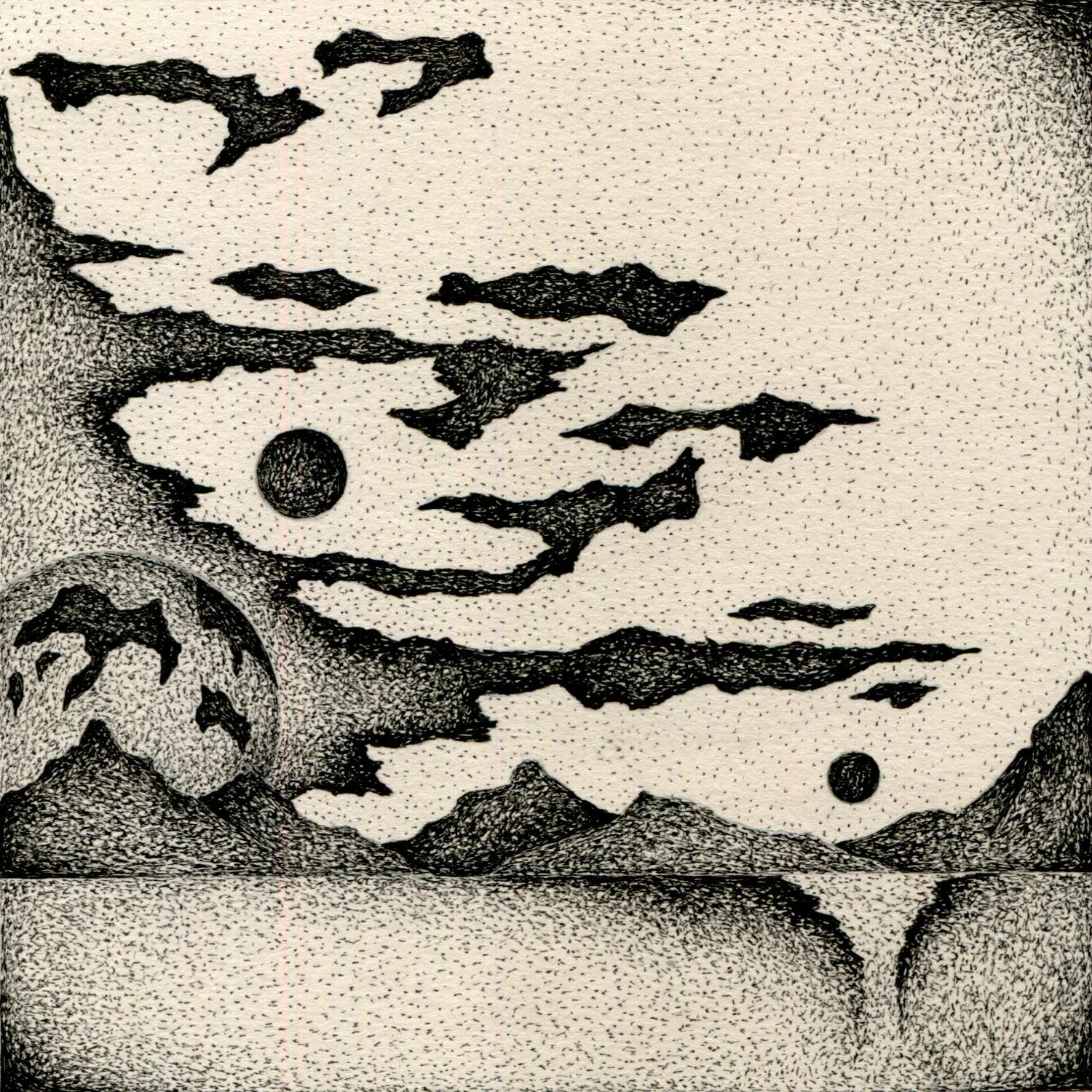
Pen and ink contemporary fine art by Doug Ashby.
It has been about twenty years since I discovered the pen and ink stippling technique I use almost exclusively in the art I put out into the world. I first heard about it in a graduate illustration course, while I was working toward my master’s in art education. My professor offered it as a passing suggestion to the whole class, something to explore for added visual interest. He did not mean we should work exclusively within it. Much as I do today, I missed that point and set out to make my first stippled artwork: a grouping of mushrooms.
I kept working that way, and as time went on I received a lot of positive feedback. That began the loop that has led me to where I am today.
The artwork above is one in a long line of hundreds, perhaps even thousands, of pieces I have made with this technique. My craft has certainly improved over the years, and I am fully committed to this form of work because it offers so much.
It is exceptionally therapeutic. This 5” x 5” piece took five hours of deep focus and attention, and that kind of immersion is deeply rewarding. On larger works, you can get lost in the repetitive motion of building an entire image from individually placed dots.
It is also visually striking, thanks to the enormous potential for contrasting values. Mastering contrast is a major leverage point for any artist who wants to catch a viewer’s eye. I love planning where a dark edge will sit beside a much lighter area, or even the bare white of the paper. That interplay of positive and negative space is something I am very conscious of when I plan my work.
Yet this piece was mostly unplanned. It came out of the automaticity that two decades of practice have built.
I recently heard Bill Gates say on the Ezra Klein Show that coding was his most developed skill. As an artist, mine is building a wide range of values and high contrast out of dots. I have plenty left to learn, but right now that is my strongest artistic skill. As an educator, my strongest skill is coaching developing artists through their entire process, from inception and planning to completion.
Oddly, I did not use that second skill when making this piece. I simply drew on older artworks that had been successful and made another. I gave little to no thought to what it would be, what it was meant to say, or what value it held beyond being interesting to look at. It was made entirely in an automatic state that I can now enter and work in for hours.
And I find myself questioning the value of that ability.
The virtue trap in the title is real. I wonder whether I need to be more conscious of it and deliberately work to move past it, so my work can grow in ways I have yet to discover. I suspect I need to add some discomfort to my process to reach the next level.
Autopilot as blessing and curse
I will start with the blessing, since I have already hinted at why it is also a curse. Stippling is laborious and incredibly time consuming. When autopilot kicks in, I can reach a deep well of flow where hours go by and I hardly notice. That is the payoff of building this skill over decades. At this stage, little conscious effort is needed to complete a compelling piece. The only key ingredient is time.
The composition of this piece also came from the blessing of automaticity. I have made many “dreamscapes,” as I like to call them, so designing this one took very little effort. There was no preliminary sketch. I simply made it up from my imagination and all my past experience making such things.
And that is where the trap lies.
Lately I have noticed that the same themes and compositional strategies keep showing up in my work. Now and then I have a breakthrough, but it is not the invention of a new trajectory. It is a small, incremental change within my comfort zone. That is fine, and it may even be what some collectors cherish. But I am standing at the edge of becoming a full-time artist and writer, and playing it safe is not the right move at this juncture. This is not the time to roll out my greatest hits and lean on them for success. That would be soul crushing, and I believe it is a sure way to become a nostalgic ghost of what I could have been.
I did not come this far to play it safe. But what does that actually mean?
I have no intention of giving up the dots. That technique is my most developed skill, and it simply needs to be applied to new areas of thought, theme, and composition. I am not entirely sure what those are yet, but architectural drawings and the idea of limited perception seem to be calling to me. How they come together in something new and exciting remains to be discovered, and that is the whole point of this life: never to stop discovering. The technical ability is now honed enough to work efficiently, so the discomfort I spoke of does not live there. It lives in the imagination, and in the new challenges I can set for myself to broaden the arc of my career.
None of this means my past will be tossed aside. Growth is a funny thing. It can be incremental, and it can arrive in bursts, but it always takes time. Works like the one above will not disappear. They will morph, and I am hopeful that from that change a new direction, and whole new worlds to explore, will open up.
As always, I hope you enjoy the art and the writing. Please leave a comment. I would love to hear your thoughts, and perhaps they will be the thing that pushes me, and pushes us, further.
Thanks,
Doug