Where Precision Meets Vulnerability, And Our Shared Anatomy
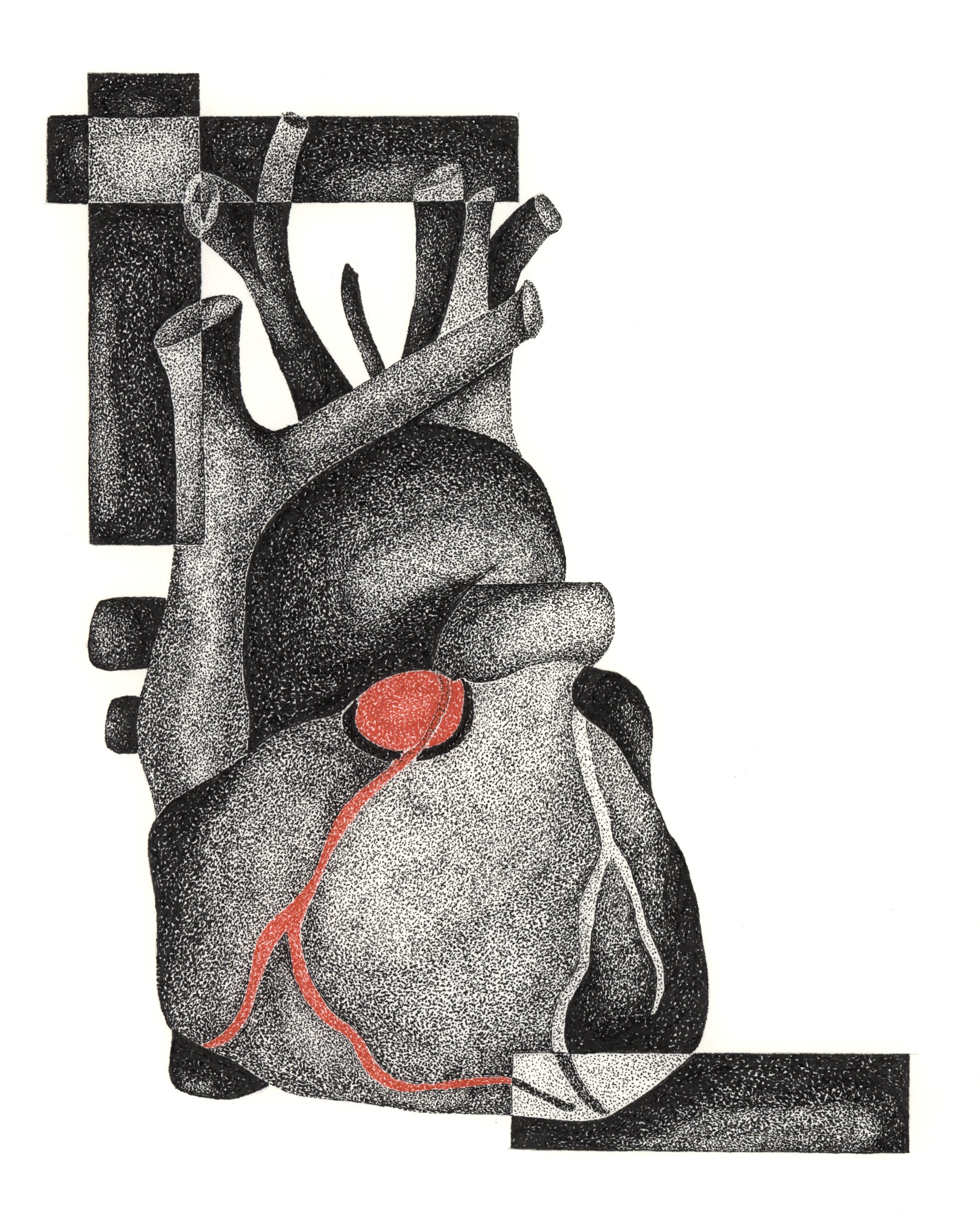
Pen and ink contemporary fine art by Doug Ashby.
Here again we encounter an older artwork. If I were to place this piece in time, I would say we are going back eighteen to twenty years—to a moment when I truly felt that art could become something foundational in my life, something I could build a career from. That belief has never left me. I still hold it, and I still desire it.
This anatomically accurate heart was part of a broader series focused on human anatomy. At the time, my intention was practical and strategic: I wanted to build a section of my portfolio dedicated to medical illustration. I was working to extend my visual language into a wider context that could support a sustainable artistic career. My interest in human anatomy runs deep, rooted in a lifelong curiosity, and anatomy has long provided artists with a rich field of exploration. Its history in art is extensive and well documented.
During this period, I was also collaborating with science teachers I worked alongside, producing medical illustrations and teaching a unit on the history of anatomical imagery, contemporary career paths in medical illustration, and guiding students as they created their own work in this field. In retrospect, this period of engagement—with both art and science—was far more encompassing than I understood at the time.
Looking back now, I ask myself what I see in this artwork that I did not see when I created it. Immediately, within the larger portfolio of anatomical illustrations, I recognize something that represents our shared commonality as human beings. At the same time, it is an object we rarely confront directly, particularly in an accurate form. When we think of the heart, we most often encounter a symbolic abstraction—a shorthand for love—rather than the complex organ itself.
What I was aiming for then was, quite honestly, a clinical exercise. I wanted to practice my technique with intention and direction. The red mark at the top of the heart was originally a deliberate design strategy—a focal point meant to draw the viewer’s eye. Color, used sparingly, creates emphasis, a principle of design I actively teach. At the time, that was the extent of its meaning.
Now, I see it differently. The red mark reads as something more metaphorical: a point of rupture, perhaps personal, perhaps collective, perhaps both—an indication of trauma. This is one of art’s enduring qualities. Art continues to communicate in ways that change over time. The artwork itself remains visually fixed, yet its meaning evolves as we do, shaped by experience, reflection, and growth.
From an academic perspective focused on process, medical illustration offers nearly limitless potential. I have always been drawn to the interaction between organic and geometric forms, to the tension created where they intersect. This dynamic works in tandem with my technique, which relies heavily on value contrasts and structural clarity. The addition of a singular, direct splash of color functions both as a compositional anchor and as a design exercise.
Yet, looking back, I cannot ignore the reality that I was experiencing a period of intense personal strain at the time. It is difficult not to wonder whether the red mark mirrors emotional states I was grappling with then. Much of my work exists within spaces of tension—between structure and intuition, control and vulnerability, humanity and nature. These tensions often reveal truths we are not consciously articulating. Art, in that sense, becomes a powerful mechanism for uncovering what lies beneath the surface.
In the years since, my work—and the intentions behind it—have become more explicitly philosophical. I recall the moment I decided I did not want to commodify myself solely for the sake of career advancement. Since then, I have created far fewer anatomical illustrations. Yet now, revisiting this work, I feel ready to see it with fresh eyes and to bring this subject matter back into my practice.
Connection and universality are recurring themes in my work. By representing something as fundamental as the heart, we reveal how sameness can illuminate difference. It is where our interior structures become visible, where precision becomes a form of reverence. Curiosity about this shared anatomy becomes the catalyst. What might seem mundane becomes fertile ground—for technical growth, yes, but also for deeper inquiry.
Within the vessels, valves, and chambers of the heart lies a compositional richness that allows for both study and interpretation. Striving for anatomical accuracy grounds the work in truth. At the same time, artistic license invites exploration beyond illustration alone. The deliberate choices I made—the isolated splash of color, the open branching of major vessels, the exposed, string-like veins—bridge my imaginative work with illustrative practice. They blur the boundary between documentation and expression.
Reflecting on this piece now, I see influences I was unaware of at the time. It is almost as if my hand would not allow me to create something devoid of meaning. This realization has repeated itself throughout my career. I have learned that I cannot sustain work that does not move me or connect to the deeper reasons I became an artist. While those reasons are not entirely clear—and perhaps never will be—I have become far more aware of the forces that motivate me.
One element still raises questions for me: the red spot itself. While its original purpose was compositional emphasis, it disrupts the anatomical neutrality of the image in a striking way. At the time of its creation, I was under significant stress, and I wonder whether this subconsciously influenced my decisions. Was I attempting to process emotional strain by visualizing physical injury? By making the invisible visible, was I creating something I needed to witness for myself?
I have written before about how my work sometimes communicates emotions I am not yet ready to acknowledge. Perhaps this was one of those moments. Trauma is universal. While our individual experiences differ and our wounds are deeply personal, many of the fractures we carry are shared.
In the end, I believe there is more to these medical illustrations than I initially understood. Can such artworks serve as reminders—perhaps even challenges—to reconsider our common humanity? Beneath our skin, we are startlingly alike. Our organs, the structures that give us life and animate our personalities, know nothing of the divisions we impose upon one another. In that sense, they become symbols of unity, inviting empathy rather than apathy—or worse, antipathy.
It may be that I give art too much credit. Yet art itself is also a shared human language.
I have not created a new medical illustration in quite some time, and I feel that may need to change. I often speak with my students about moments when the creative well runs dry—when accessing inspiration feels difficult, yet the work must continue. For me, flowers have often served as a reliable entry point during those periods. Perhaps medical illustration can return to that role as well: a peripheral but dependable source of inspiration, an infinite spring that intersects with, rather than defines, my artistic identity.
Such projects offer discipline, clarity, and curiosity—companions artists need when momentum falters and inspiration seems elsewhere.
So what have I learned through reflection? Art grows alongside the viewer. It changes over time. I now see this heart not simply as an object, but as a site of meaning—both personal and collective. The red mark is no longer merely a design exercise, but a reminder of shared vulnerability. The magic of art lives in the interplay between accuracy, design, symbolism, and personal narrative—one that, at its core, reaches beyond the individual.
What began as a medical illustration has become a bridge—revealing the undeniable unity between our physical and emotional selves.
As always, I hope you enjoyed the artwork and the writing. If you have any thoughts you’d like to share, please feel free to leave a comment. I promise I will respond.
Thanks,
Doug